A photography blog that focus on Pakistan natural beauty, people, culture heritage, customs and traditions, historical places, travel destinations, wildlife: flora and fauna.
Showing posts with label Arachnids. Show all posts
Wolf Spiders
Wolf spiders are members of the family Lycosidae (wolf). Wolf spiders are agile and land predators that are moving quickly. Wolf spiders have good eyesight. Some hunt actively and pursue prey during the day. Some will wait for passing prey in or near the mouth of a burrow. They do not capture their food in a web as do other common spiders with poorer eye sight.
Adult males are smaller than females, and measure 19 to 25 mm . The pedipalps, are larger and proportionately longer legs. Its color is also more striking. The female is brown with darker markings and lines on the legs. Measures of 27 to 30 mm. They have eight eyes, arranged in 3 rows; the first rows have 4 small eyes; the second row has 2 larger eyes and the third row has 2 medium-sized eyes.
Wolf spiders carry their egg sacs by attaching them to their spinnerets. On hatching they protect their young by carrying them on their back.
Wolf spiders are venomous and can bite if provoked. However their bite are usually minor, can result in small pain or itchiness. In some rear cases the reaction can include swelling, prolonged pain, dizziness, rapid pulse and nausea.
Wolf Spiders
Red Spider Mite
Red spider mite is one of many species of plant-feeding mites belong to family Tetranychidae (spider mites). The spider mites are arachnids, related to spiders. Red spider mite is tiny, crawling, wingless pest that suck the plant's sap from leaf surfaces, causing a heavy damage to plant. They start life with six legs, but develop eight as they grow mature.
Red Spider Mite
Daddy Long-legs Spider
Daddy Long-legs Spider (Artema atlanta) is a species of spider in the family Pholcidae. Daddy long legs spider is the common house spiders. It has exceptionally long legs, as compared to the body size. The female body length is about 10mm and legspan is about 50mm (based on single measurement). Daddy long legs spiders are known to be one of the most venomous spiders of the world. However, they are not dangerous for humans, because their fangs are too small to bite or puncture the human skin. They are very common in our houses, but never observed their bite. The spiders in the family Pholcidae are known by a number of common names, including cellar spider, vibrating spider, house spider, daddy long-legger or granddaddy long-legs spider. It's known as "Vibrating Spider", because it vibrates itself and the web as a defense mechanism, whenever it feels threatened.
Daddy Long-legs Spider (Artema atlanta) Male
Daddy Long-legs Spider (Artema atlanta) Female
![]() |
| Daddy Long-legs Spider Molting |
Ghost Spider - Neoscona punctigera
The Ghost Spider (Neoscona punctigera) is a brown colored species of orb-weaver spiders in the family Araneidae. It has a hairy body and its legs are covered with spines. It's a nocturnal species. It constructs its web at night, shortly after sunset and removes the web next morning. During the day, it hides among the leaves. When at rest, it assumes a shape that looks like a monkey (first Pic) and that's why it is also known as "monkey spider"
Ghost Spider (Neoscona punctigera)
Yellow Sac Spider
The Yellow Sac Spider is a common name for certain species of spiders in the genus Cheiracanthium, family Miturgidae. They are usually pale yellow in color and has a body length of 6 to 10 mm. Being nocturnal, yellow sac spiders are active in the night and search for their prey. They don't build webs. Instead they construct sacs in protected areas and that's why they are known as Sac Spiders. Their bite is believed to be venomous to humans. Therefore, they should be handled very carefully.
Yellow Sac Spider
Thanks to Mr. Glen of spiderz rule for identification help.
Huntsman Spiders
![]() |
| Huntsman Spider |
The Huntsman Spiders also known as Giant Crab Spiders, are spiders in the family Sparassidae. They are known as rain spiders in southern Africa. The species in the picture has a leg span of about 50mm. Most huntsman spiders are brown or gray. Their legs are covered with spines. They have two claws at the tip of each tarsus. Huntsman spiders do not build webs for catching prey, but rather hunt and forage for their food. They basically feed on insects and other invertebrate.
Huntsman Spiders
Furrow Orb weaver Spider
This Furrow Spider or more specifically Furrow Orb weaver Spider (Larinioides Indica) belong to genus Larinioides, family Araneidae (Orb Weavers). Thanks to Mr. Glen of spiderzrule.com, who helped me in identification of this spider, however he didn't give a scientific name to the species, so I gave it a scientific name of (Larinioides Indica).
Furrow Orb Weaver Spider (Larinioides Indica)
Granddaddy Long Legs
Granddaddy Long Legs or Harvestmen are arachnids like spiders, but belong to a different order Opiliones, where as spiders belong to order Araneae. In spite of the fact that harvestmen and spiders belong to different orders, due to their resemblance some people called them "Granddaddy Long Legs Spiders" or "Harvestmen Spiders". Harvestmen and spiders are different in many aspects. Harvestmen have one body part, while spiders have two body parts (cephalothorax and abdomen). Harvestmen have two eyes, while spiders have eight eyes. They don’t have silk glands like spiders. Moreover They don't have venom glands and are harmless to humans. They eat decaying plants, small insects, mites, fungi, bird dropping and other fecal material.
Harvestmen (Granddaddy Long Legs)
White Crab Spider
White Crab Spider (Thomisus spectabilis) also known as White Flower Spider is a beautiful species of spiders in the family Thomisidae. They have a body length from 4mm to 10mm. The male is smaller then female. They are found in white, yellow and greenish colors. They sit on flowers or top leaves of branches and uses camouflage and ambush technique to capture their prey. Flower spiders generally feed on nectar feeding insects such as butterflies, moths and bees.
White Crab Spider
A White Crab Spider with beautiful patterns.
Posted by
Birdy Official
Labels:
Arachnids,
Crab spiders,
Flower spiders,
Spiders,
White spiders
17 comments:
What Do Spiders Eat?
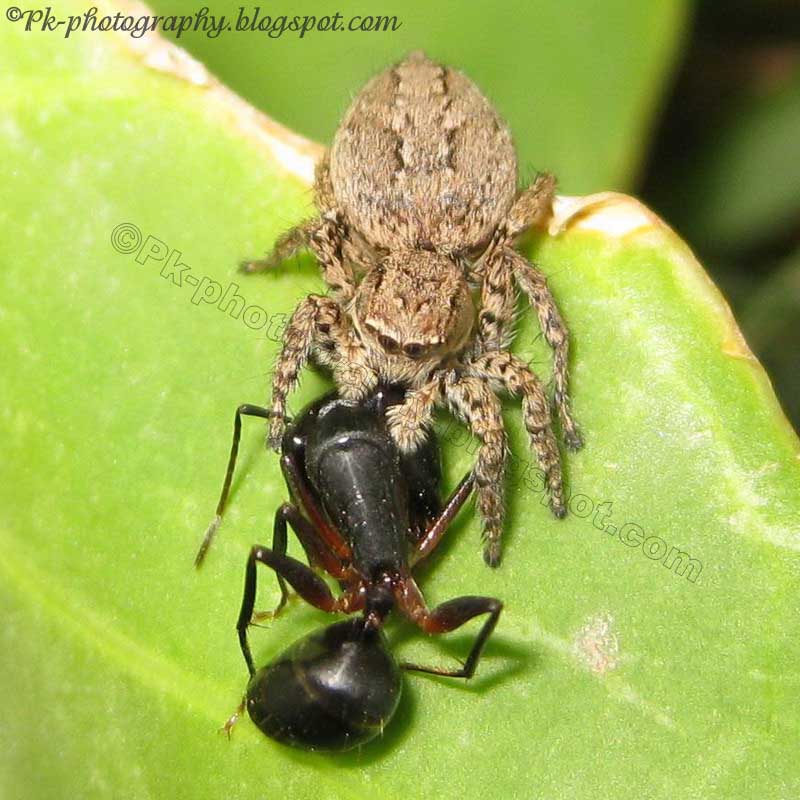
What Do Spider Eat? Generally spiders eat a variety of things like flies, bees, wasps, ants, crickets, grasshoppers, beetles, bugs, caterpillars and even other spiders. Some large species eat small birds and lizards. However a non predator species of jumping spider feed on the nubs produced by acacia trees. Baby spiders also feed on nectar and pollen caught in the webs. Here are some pictures of spiders with prey for the best explanation of What Do Spiders Eat?
What Do Spiders Eat?
A slideshow of What Do Spiders Eat?
Posted by
Birdy Official
Labels:
Arachnids,
Spiders,
Spiders with prey,
What do spiders Eat?
8 comments:
Subscribe to:
Posts (Atom)