Paris Peacock Butterfly


The Paris Peacock (Papilio Paris) is a beautiful green colored butterfly in the family Papilionidae (swallowtail butterflies), found in northern areas of Pakistan. I saw this butterfly for the first and last time in May 2008, before starting this blog. They were mud-puddling in a large number on the bank of a stream in Dara Gokand, district Buner.

Paris Peacock Butterfly

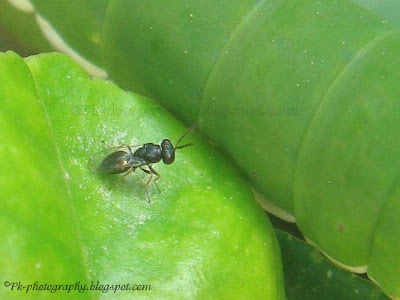
Parasitic Wasp-Pteromalus puparum

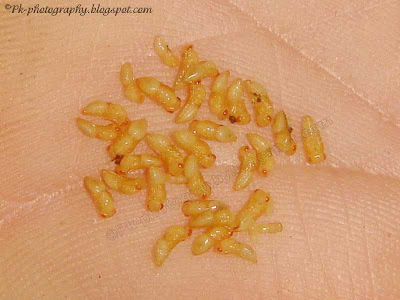
This year most of the pupae (about 90%), I found in nature were parasitized by Pteromalus Puparum. Pteromalus puparum is a small (about 3mm long) parasitic wasp in the order Hymenoptera, superfamily Chalcidoidea, family Pteromalidae, that develops inside butterfly pupae. The wasp deposit eggs inside the skin of the pre-pupa caterpillar or puparial wall of the newly formed pupa. The eggs hatch into larvae, which consume the inside organs of pupa and on maturity turn into pupae. The mature wasps emerges from host pupa through a tiny hole. Pteromalus puparum is consederd biological control of caterpillar pests particularly cabbage white butterfly and that is why it's known as "Cabbage White Butterfly Pupal Parasite". According to my personal observations the pupae parasitized by Pteromalus puparum wasp, were include pupae of  plain tiger, cabbage white, bath white, citrus swallowtail and ladybug.

Parasitic Wasp-Pteromalus Puparum
Parasitic Wasp-Pteromalus Puparum on Caterpillar
Parasitic Wasp-Pteromalus Puparum
Pteromalus Puparum Larvae
Parasitic Wasp-Pteromalus Puparum
Pteromalus Puparum Larvae
Parasitic Wasp-Pteromalus Puparum
Pteromalus Puparum Pupae
Parasitic Wasp-Pteromalus Puparum
Pteromalus Puparum Pupae

Pakistan Flood-affected Children

On 11th September (next day of Eid-ul-fitr) we visited the flood affected families, who reside in different schools of Jahangira and Akora Khattak (Khyber Pakhtunkhwa) to distribute our last package of food. We bring food for about 2500 people. In each camp we handover food to camp incharge, so no direct interaction with flood affectees. However in Government Centennial Model High School Akora Khattak we went inside to distribute food. As we enter the school premises, the kids present there rush toward us to shake hand with us. This was unexpected but exciting situation for all of us. According to our tradition on Eid-ul-Fitr children receive money (Eidi) from their elders. So we decided to give some money to children. We line up them for better distribution. I saw hope and happiness on their faces as we handed money to them. Here are some pictures I took at that occasion.

Flood-affected Children

Long-Legged Fly


Today I'm presenting a few images of an unknown species of Long-Legged Fly found in our area. They can be easily find out on the upper surface of leaves, enjoying sunlight. The Long-Legged Flies or Dolichopodidae is a family of true flies in order, Diptera, consistes of more than 7,000 species. They are tiny flies with long legs and big eyes, having metallic green, blue or copper color bodies. These flies are predatory on smaller insects.


Long-Legged Fly
Long-Legged Fly

Haripur Pakistan

Haripur is a district in the Hazara region of the Khyber Pakhtunkhwa province of Pakistan. Haripur was founded in 1822 by Hari Singh Nalva, a Sikh General of Ranjit Singh's army. It has two tehsils; Haripur and Ghazi. The population of Haripur is about 9 lakh. Over 70 percent of total population speak Hindko. The area is rich in natural resources, including two very important water reservoirs; Tarbela dam and Khanpur dam. Hatar industrial state at Haripur play a vital role in the country economic development.

Haripur Pakistan
Haripur  Pakistan
Haripur  Pakistan
Haripur  Pakistan
Haripur  Pakistan
Haripur  Pakistan
Haripur  Pakistan
Sirikot
Haripur  Pakistan
Sirikot
Haripur  Pakistan
A Traditional Pakistani Bus In Haripur

Ambela Buner

Ambela is a small and beautiful village in Buner, Pakistan. It's the entrance of Buner Valley from District Mardan. Ambella is famous for "Ambela War 1863", which was fought between Mujaheddin and British army. I will post some detail of the war after consulting with my friend and colleague Mr. Rahim Zada, who has research on Ambella War. Personally I like this place for three reasons, It's natural beauty, moderate weather and a water well, which is famous for it's cool and hygienic water.

Ambela Buner Valley
Good Bye Sign boards at Ambela from Family Planning Department Buner and District Nazim Rauf Khan.

Flat-tailed House Gecko-Cosymbotus platyurus

 Flat-tailed House Gecko (Cosymbotus platyurus or Hemidactylus platyurus) is a member of family Gekkonidae. This a common species found in Pakistan. There will be hardly any house where there is no Flat-tailed House Gecko. In the night they can be found easily around the lights, waiting for their prey. In the day they hide in a darker place. They are commonly known as House Lizard or Wall Lizard. In Urdu they are known as chipkali (چھپکلی).
House Gecko
House Gecko

Let me share a sad incident, which occur in our village, because of a house gecko. Three kids of a family died after drinking milk. When they check the milk pot, there was a dead house gecko at the bottom. No one did a chemical analysis of the milk. However this incident lead to a general concept among the villagers that the house gecko is poisonous and should be keep away from the food articles.

House Gecko (Cosymbotus platyurus)
House Gecko
House Gecko
House Gecko-چھپکلی
House Gecko Young Ones
House Gecko Eggs
House Gecko Eggs
Related Posts Plugin for WordPress, Blogger...