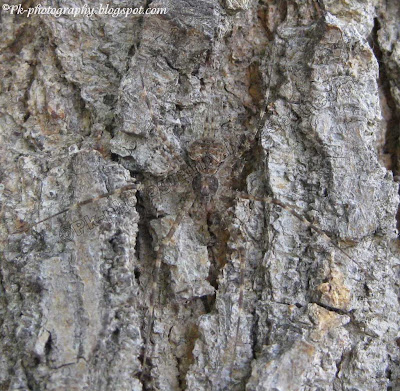
Two-tailed Spiders

Two-tailed Spiders (Long-spinnered Bark Spiders) are a genus (Hersilia) of tree trunk spiders in the Hersiliidae family. They are known as Two-tailed spiders, because of their two enlarged spinnerets. They can't be found easily, because of their brown color that camouflage the tree bark very well. They have long striped and spiny legs. They live on a tree trunk and don't build web or shelter. They sit on tree trunk all the day and night waiting for their prey. Below are the pictures of a same spider taken with and without flash.

Two-tailed Spider Pictures
Two-tailed Spider Picture

Common Emigrant Butterfly Life Cycle

Here are some pictures representing four stages of the life cycle of common emigrant butterfly.

1st Stage-Eggs

The female common emigrant butterfly lays its spindle shaped yellowish eggs individually on the back side of the host plants (Cassias). The main host plant in our area is sickle senna (Cassia obtusifolia or Senna obtusifolia).

Common Emigrant Butterfly Egg

2nd Stage-Larva (Caterpillar)

The caterpillar of common emigrant has agreen rough body with tiny black spots and a white lateral line sandwiched between an upper black spotted-line and a lower olive green stripe. The caterpillar reach a maximum length of about 35mm. The mature caterpillar generally stuck itself head-up under the leaf of the hostplant. A silken girdle helps it to stay in an upward position. The larval stagis completed in about two weeks.

Common Emigrant Butterfly Caterpillar
Pre-pupa Caterpillar


3rd Stage-Pupa (Chrysalis)
The common emigrant butterfly pupa (measuring 20mm in length) has bright pale green color, having a yellow color line on each side running from head to tail. There is also a yellow line on the top of thorax. The color become dark with the passage of time. As the pupa mature, it's become transparent. The pupa stage lasts for about 6-7 days.


Common Emigrant Butterfly Pupa (Chrysalis)


4th Stage-Adult Butterfly

The Common Emigrant (Catopsilia pomona), also called the Lemon Emigrant or Lemon Migrant, is a medium-sized (wingspan: 45mm-60mm) pierid butterfly found in Asia and Austrealia. This butterfly gets its name from the migration habit.
They have a great variability in colors and marks. Both the male and female have pale white upper side with a black spot at the distal end of the forewing cell though this spot is sometimes absent in the male. In the male, the upper side of the apex of the forewing is narrowly black and continues partway along the termen and costa. In the female, the black bands are wider and are continued along the entire length of the costa and termen.
The male has a sulpher or pale green underside with or without a radish-brown spot on both the forewing and hindwing. The female has pale yellow underside with radish-brown spots including three or two white centered spots. In both sexes, except for a small area on the lower half of the forewing, which is unmarked, the remaining areas are marked with very fine brown lines.

Common Emigrant Butterfly (female)

Common Emigrant Butterfly (Male)
Common Emigrant Butterflies Mating Pair

Host Plant Cassia obtusifolia (Chinese Senna or Sicklepod)


Leaf Curling Spider

Leaf Curling Spiders (Phonognatha graeffei) belong to family Araneidae (Orb-weavers). The spider here is a fresh leaf curling spider. They build their retreat with fresh green leaf. Most of the time they remain in their leaf retreat. They build their web near the retreat and when a prey fall on its web, it quickly pick it up from the web and go back to its retreat. The spider has a green color from under including legs and white abdomen from top. It has a yellowish-green head. It has some black spots and wavy lines on abdomen. It also has yellow and blue colored strips on abdomen. Here are some pictures of the spider taken from different angles, hoping you will like them.

Leaf Curling Spider
Fresh Leaf Curling Spider

Lime Butterfly Caterpillar

The Lime Butterfly caterpillar passes through 5 different instars before pupation. The first few instars of the caterpillar look like bird droppings and this is nature's way of protecting them from predators. In the 5th (last) instar, the caterpillar becomes pale green with a yellow subspiracular band having brown and bluish marking and a pair of false eyes. An additional yellow band is developed on the 4th and 5th segments with bluish spots on it.
Lime Butterfly Caterpillars
Lime Butterfly Caterpillar (1st instar) eating egg shell
Lime Butterfly Caterpillar (2rd instar)
Lime Butterfly Caterpillar (3rd instar)
Lime Butterfly Caterpillar (4th instar)
Lime Butterfly Caterpillar (5th and last instar)
Lime Butterfly Caterpillar (Pre-pupa)

Blue Pansy Butterfly

The Blue Pansy (Junonia orithya) belong to the family Nymphalidea, is a medium size butterfly with a wingspan of about 40-50mm. It's a sun-loving species, which can usually be found on grassy patches in open areas, often sitting on bare ground. The blue pansy is very common in Pakistan.

Blue Pansy Butterfly
Blue Pansy Butterfly Mating
Blue Pansy Butterfly Camouflage
Blue Pansy Camouflage

Lime Butterfly Eggs

Lime Butterfly (Papilio demoleus malayanus) lay her eggs singly on the young leaves of the host plant (various Citrus species). The egg has a round shape and measuring about 1mm in diameter. Its color changes from white (transparent) to yellowish and then brown with the passage of time. The eggs take about six days to hatch.

Lime Butterfly (Papilio demoleus malayanus) Eggs

Danaid Eggfly Butterfly

 The Danaid Eggfly (Hypolimnas misippus), is a medium sized butterfly (with a wingspan of about 70-85 mm) belong to family Nymphalidae. It is well known for polymorphism and mimicry. The Upperside of male is velvety dark brownish black, with two oval white patches, one on the forewing and the other on the hind wing. There is another smaller white patch below the apex of the forewing. These pitches are surrounded by blue or violet rings which extends towards the center of the white patches. The underside has a beautiful golden brown color, with white bands and spots on each wing. The underside wings have black wavy margins with white spots. The female of the species mimics the plain tiger. It's also known as the Diadem or False Tiger.

Danaid Eggfly Butterfly
Male Danaid Eggfly Butterfly (Upperside)
Male Danaid Eggfly Butterfly (Underside)
Female Danaid Eggfly Butterfly
Female Danaid Eggfly Butterfly picture
Female Danaid Eggfly Butterfly Caught by a Spider
Related Posts Plugin for WordPress, Blogger...