A photography blog that focus on Pakistan natural beauty, people, culture heritage, customs and traditions, historical places, travel destinations, wildlife: flora and fauna.
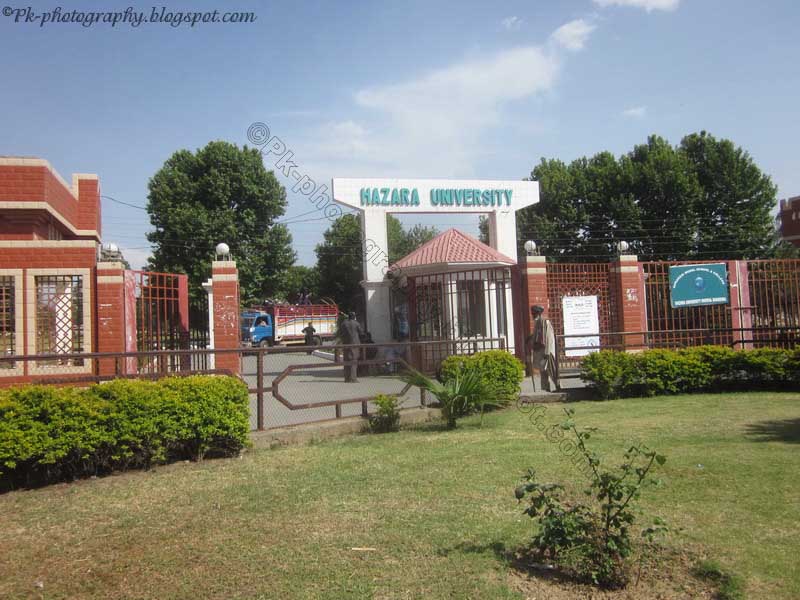
Hazara University Mansehra
The first draft of Hazara University (ہزارہ یونیورسٹی) Act was prepared by Higher Education Department, KPK and the University Grants Commission (Now Higher Education Commission) in 1995. Two years later, in 1997, the KPK Provincial Assembly passed Hazara University Act in 1997 and Lt. Gen. (R) Syed Iftikhar Hussain Shah Governor KPK took the bold step of establishing Hazara University in the Neuropsychiatry Hospital, Dhodial, Mansehra, in 2002.
The campus of Hazara University is situated 14 kilometres to the north of Mansehra town on the right side of Karakuram Highway in a serene, peaceful, rural, pollution free environment. The patches of the green pines across the sprawling campus enhanced its natural location and accentuate the harmonious calm of its location. The vast plain of Pakhal with its agricultural wealth irrigated by the River Siran and tea gardens surround the University. Towards the northeast the hills are covered with the dense forest and in the background far beyond the lofty peaks of the snow-covered mountains of Kaghan Valley add to its panoramic attraction. On the western, southern and the eastern sides the rolling ranges of the hills offer the captivating scene.
The gentle and the fresh wind blowing across the campus waft an invigorating freshness so conducive for learning environment.Hazara University with its immaculate natural surrounding appears to have a far superior location with a formative influence, which serves as the educator of senses and mind alike. The most famous and attractive summer resorts of Kaghan Valley, Galliyat and Siran Valley with fascinating mountains and hills are at a convenient distance of a few hours drive from the University Campus, linked with wide metal-roads. The transport facilities to these places of attraction are available at any hour of the day and night.
Source: www.hu.edu.pk
Hazara University Mansehra
![]() |
| Main Gate |
![]() |
| Inauguration Stone |
![]() |
| Administration Block |
![]() |
| Guest House |
![]() |
| General Purpose Hall |
![]() |
| A Burned Boy Hostel |
![]() |
| A View of Rose Garden and Girl Hostel |
![]() |
| Conservation Information Center |
Lesser Grain Borer - Rhyzopertha dominica
The Lesser grain borer (Rhyzopertha dominica) is a beetle in the family Bostrichidae. The a-d-u-l-t beetle is dark reddish-brown and about 2.5-3 mm long. The head is concealed beneath the prothorax and is invisible when viewed from above. It is a very destructive and widespread pest of wheat and other stored grains. It bores through grains. It's consider more destructive than Rusty grain beetle and Granary weevil. Being a strong flies they can easily migrate from one grain storage to another.
Lesser Grain Borer - Rhyzopertha dominica
Silverfish-Lepisma saccharina
Silverfish (Lepisma saccharina) also known as Fishmoth, are small, soft, wingless insects in the family Lepismatidae, order Thysanura. Silverfish are nocturnal, elongated and flattened insects approximately 13-25 mm long. The nymphs look like adults, but are smaller and having whitish color, but as they grow and molt, they develop a greyish hue and metallic shine. They have long antennae and three long filaments (cerci) at the tips of their abdomens. Contrary to other members of order Thysanura, which are eyeless, Silverfish have two small compound eyes.
Their fish-like appearance and wiggling motion that resembles the movement of a fish, give them the common name Silverfish. The scientific name indicates the silverfish's diet of carbohydrates such as sugar or starches.
Silverfish prefer vegetable matter with a high carbohydrate and protein content. However, indoors they will feed on almost anything including flour, starch, paper, gum, glue, cotton, linen, rayon, silk, sugar, molds, dried meats, leather and dead insects.
Silverfish Bugs
Subscribe to:
Posts (Atom)