Showing posts with label Plants. Show all posts
Showing posts with label Plants. Show all posts


Vitex negundo
Vitex negundo, commonly known as the five-leaved chaste tree a small erect tree in the family Lamiaceaeis, that can reach up to 5 meters tall. The plant has evergreen leaves, usually with five lanceolate leaflets per leaf. Flowers are numerous, blue to lavender, 6 to 7 mm long, borne on 10 to 20 cm long terminal panicles . Vitex negundo is widely used in folk medicine. Leaves, seeds, bark and roots are used for the treatment of various illnesses including cough, colds, fever, headache, toothache, asthma, menstrual difficulties and amenorrhea.


Vitex negundo


Field Bindweed
Field Bindweed (Convolvulus arvensis) is a species of bindweed in the family Convolvulaceae (morning glory family ), native to Europe and Asia. It is a climbing or creeping herbaceous perennial plant growing to 0.5–2 m high. The leaves are spirally arranged, linear to arrowhead-shaped, 2–5 cm long and alternate, with a 1–3 cm petiole. The flowers are trumpet-shaped, 1-2.5 cm diameter, white or pale pink, with five slightly darker pink radial stripes. It's one of the most troublesome weeds of agricultural fields and gardens throughout temperate regions worldwide.


Field Bindweed Flowers


Milk Vetch
Milk Vetch or Milkvetch is a common name used for the plants species in the genus Astragalus (milkvetches), family Fabaceae. The species here is most probably Astragalus exscapus. It is a perennial flowering plant, produces yellow colored flowers in spring . It has pinnately compound leaves, grows up to 12 inch long. It grows wildly along field sides.


Milkvetche (Astragalus exscapus )


Wild Snake Gourd
Wild Snake Gourd (Trichosanthes lobat), also known as bitter snake gourd is a slender annual monoecious climber in the family Cucurbitaceae. It grows wildly in the hilly area of KPK, Pakistan. The unripe green fruits are cooked as a vegetable.


Wild Snake Gourd (Trichosanthes lobat)


Adhatoda vasica
Adhatoda vasica (syn. Justicia adhatoda ) commonly known as Malabar Nut is a small evergreen plant in the family Acanthaceae. It's native of Asia, grows wild in India, Pakistan, Sri Lanka, and Nepal. Its broad and smooth-edged, lanceolate leaves measuring 4 to 6 inches in length
and 2 inches wide. The flower
has large, white petals, streaked with purple on the lower
lip. The fruit is a small capsule with 4 seeds. It's traditionally used for the treatment of many ailments including fever, rheumatism, cough,
asthma, bronchitis and tuberculosis. It is the provincial flower of the Punjab province of Pakistan.
In local language Pashto it's known as Bhekkar.


Adhatoda vasica


Punarnava-Boerhavia diffusa
Punarnava (Boerhavia diffusa), also know as spreading hogweed, pigweed, tar vine,Wineflower or red spiderling, is a species of flowering plant in the family Nyctaginaceae (four o'clock family). The word Punarnava meaning that which rejuvenates or renews the body. The leaves of Punarnava are often used as a green vegetable. It is used in herbal medicine for liver disorders including jaundice and hepatitis. It is believed to improve and protect eyesight. It has diuretic properties and is used by diabetics to lower blood sugar. Boerhavia diffusa is widely used for the treatment of jaundice in the animals and is proved very effective.


Punarnava-Boerhavia diffusa


Indian Catmint-Anisomeles indica
Indian Catmint (Anisomeles indica) also known as Malabar Catmint is a species of flowering plant in the family Lamiaceae (Mint family), subfamily Lamioideaeis. The plant grows 1-2 m tall and produce purplish blue flowers, 1-1.2 cm long. Flowering season is from August to late fall. The Indian Catmint is considered as medicinal plant and is traditionally used for the treatment of many ailments, including rheumatism, abdominal pain, colds, fevers, skin sores and snake bites. Recent studies show that the plant is also effective against HIV and Cancer.


Indian Catmint (Anisomeles indica)


Benghal Dayflower-Commelina benghalensis
Benghal Dayflower (Commelina benghalensis), also known as Tropical spiderwort is a perennial herb in the family Commelinaceae, subfamily Commelinoideae, tribe Commelineae. It produces blue colored flowers, which appear from spring to fall. It is usually considered a weed of economic consideration. It is a serious weed of maize crop in Pakistan. The plant has no local use, even farmer avoid it to feed to cattle. Locally it's known as Kanchara


Benghal Dayflower (Commelina benghalensis)


Opium Poppy Pods
The Opium Poppy Pod is the most important part of the opium poppy pant, from which the opium (lachryma papaveris) is extracted. The latex obtained from poppy pods contains morphine, codeine, papaverine, thebaine and noscapine. The morphine is converted into heroin, an opiate drug. To obtain the latex the immature seed pods is scratched in the result of which the latex leaks out and dries to a sticky yellowish residue that is later scraped off.
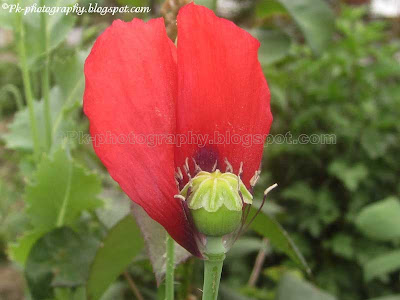


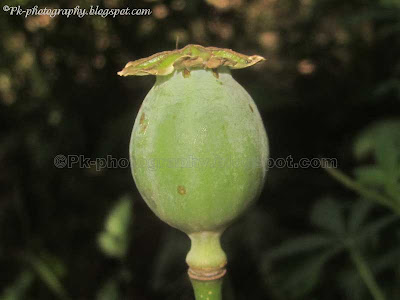


Opium Poppy Pods


Subscribe to:
Posts (Atom)
